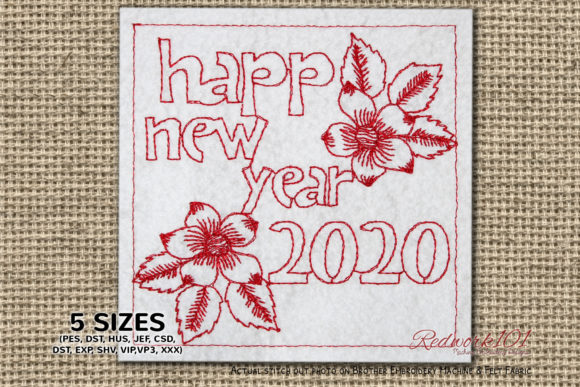
Happy New Year Floral Redwork: A Merch Review
As an experienced embroidery designer who frequently consults with small businesses on their branded merchandise, I approach every new machine embroidery design with a critical eye for commercial viability. When evaluating the Happy New Year Floral Design Redwork, my primary focus is not just on its aesthetic appeal as a seasonal motif, but on its functionality as a versatile asset for small business merch. This review breaks down how this specific digital embroidery file performs in real-world production scenarios, from staff uniforms to customer giveaways, and offers technical guidance for achieving professional results.
First Impressions: Professional Warmth and Versatility
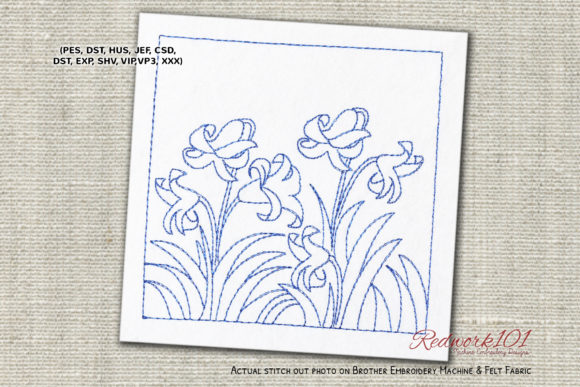
Upon loading the Happy New Year Floral Design Redwork into my digitizing software, the immediate impression is one of classic elegance mixed with approachable warmth. Redwork, by definition, relies on line work and negative space rather than heavy fill stitches. For a business owner, this is a significant advantage. The design feels handmade and artisanal, making it particularly suitable for boutiques, bakeries, florists, and creative studios that want to convey a sense of craftsmanship. Unlike dense, logo-heavy corporate designs, this floral motif suggests a friendly, welcoming atmosphere.
The inclusion of the optional box stitch mentioned in the product description is a crucial feature for commercial adaptability. In my experience testing similar assets, the ability to remove or modify the outer frame allows the design to transition seamlessly between different applications. With the box, it functions as a structured badge or label; without it, the organic floral shape works better as a chest accent or sleeve detail. This flexibility is essential for maintaining consistent brand identity across various products without needing multiple distinct files.
Commercial Applications for Small Business Merchandise
For small business owners and Etsy sellers, maximizing the ROI of a single embroidery file is vital. The Happy New Year Floral Design Redwork offers several high-value application points:
- Staff Aprons and Uniforms: The redwork style typically has lower stitch density, which prevents the fabric from puckering on lightweight aprons or work shirts. It adds a festive yet professional touch to staff attire during the holiday season without feeling like a cheap novelty.
- Tote Bag Design: Canvas tote bags are a staple for retail and markets. This design scales beautifully on canvas, providing a premium look that encourages customers to reuse the bag year-round. The linear nature of redwork penetrates thick canvas effectively without excessive thread buildup.
- Customer Gifts and Packaging: Embroidered patches created from this design can serve as value-adds for orders. Because the design is not overly dense, production time per patch is reduced, making it cost-effective to create handmade product tags or gift accents.
- Seasonal Event Merch: For businesses hosting New Year’s events or workshops, this motif serves as excellent commemorative merchandise. Its timeless floral quality ensures it remains relevant even after the specific year has passed, extending the shelf life of your inventory.
Technical Considerations and Production Limitations
While the Happy New Year Floral Design Redwork is versatile, it requires careful handling in specific commercial contexts. As a reviewer, I must highlight where caution is necessary to avoid production failures or subpar finished goods.
Cap Embroidery and Curved Surfaces
Redwork designs can be tricky on caps due to the lack of stabilizing fill stitches. If you intend to use this for cap embroidery, you must verify the design's center-out sequencing. On curved surfaces, linear designs can distort if not properly compensated. I recommend running a test sew on a scrap cap before committing to bulk production. If the design lacks specific cap compensation, consider using it only on flat-brimmed hats or adding a light backing fill to stabilize the registration.
Sizing and Detail Retention
Because this falls under the Single Flowers category, resizing requires attention to detail. Reducing the design too much for tiny collar tags or sleeve cuffs may cause the running stitches to merge or become indistinguishable. Always check the minimum recommended size in your software. Conversely, enlarging it significantly for back-of-jacket prints may make the single-ply lines look sparse. For larger formats, verify if the thread colors and stroke widths scale proportionally to maintain visual weight.
Fabric Texture and Stabilizer Selection
The success of this commercial embroidery project heavily depends on your stabilizer choice. On textured fabrics like linen or terry cloth, fine redwork lines can get lost. Use a water-soluble topping to keep the stitches crisp and visible. For stretchy knits used in apparel, a cut-away stabilizer is non-negotiable to prevent the design from warping after washing. Always match your stabilizer to the fabric texture to ensure the design remains legible and professional.
Impact on Brand Identity and Customer Perception
Incorporating the Happy New Year Floral Design Redwork into your product line does more than decorate an item; it signals specific brand values. The redwork technique historically associates with heirloom quality and tradition. For modern businesses, this translates to trust and attention to detail. Customers perceive embroidered items as higher value than printed alternatives, and the delicate nature of this specific design reinforces a boutique, curated aesthetic.
Furthermore, the optional box element allows for strategic branding. You might use the boxed version for official staff uniforms to denote authority and structure, while using the unboxed floral version for casual customer merchandise to evoke friendliness. This duality helps maintain visual consistency while adapting to different audience touchpoints. However, always ensure the design aligns with your existing design assets. If your brand is ultra-modern and minimalist, verify that this traditional floral style complements rather than clashes with your current visual language.
Essential Designer Notes Before Production
Before you hoop your first garment, follow this professional checklist to ensure the Happy New Year Floral Design Redwork meets your business standards:
- Verify Commercial Licensing: Never assume usage rights. Confirm that the license permits commercial sale of finished products and mass production limits before listing any merch.
- Test in Black and White: Print a grayscale template or sew a test in black thread on white fabric. This reveals spacing issues and registration errors that colored threads might hide.
- Create a Printable Mockup: Before investing in thread and blanks, place the design digitally on photos of your actual products. Share this printable mockup with stakeholders or use it for pre-orders to gauge interest.
- Check Hoop Size Compatibility: Ensure the design fits within your machine’s maximum embroidery area with adequate margin for hooping. If the optional box pushes the dimensions beyond your hoop, edit the file to remove it or resize appropriately.
- Evaluate Thread Contrast: Redwork traditionally uses red, but for branding, you may need to match your corporate palette. Test alternative thread colors on your specific garment color to ensure sufficient contrast. Light thread on light fabric will disappear; dark thread on dark fabric loses detail.
- Inspect the Optional Box Logic: Open the file and identify which color stop controls the outer box. As noted in the description, this color often differs. Mark this stop clearly in your machine’s interface so operators can easily skip it when producing unboxed variations.
The Happy New Year Floral Design Redwork represents a strong opportunity for small businesses to elevate their seasonal merchandise with a touch of handmade sophistication. By understanding its technical parameters and leveraging its adaptable features, you can transform a simple floral motif into a powerful tool for brand recognition and customer engagement. Always prioritize testing and proper stabilization to ensure your finished product reflects the quality your business stands for.